The landscape of cyber threats is evolving rapidly. What was considered cutting-edge defense yesterday is often just baseline today. At the center of this constant change is Artificial Intelligence, not as a cure-all but as a powerful tool that fundamentally reshapes how we detect threats and respond to incidents. At Cybersecurity Analytics we see daily how this evolution affects our clients’ work and our own analysts. The goal is not to replace humans with machines but to augment and accelerate human expertise with intelligent systems.
The old world: alert fatigue and burnout
Remember when security teams were overwhelmed by a sheer flood of alerts? SIEM systems spat out thousands of warnings per day, many of them false positives or simply irrelevant. Analysts spent hours sifting through logs, manually correlating events, essentially searching for a needle in a haystack. The result was fatigue, burnout and, worst of all, missing real threats buried in the noise. Traditional rule-based detection hit its limits as attackers tweaked their tactics even slightly.
AI as an intelligent filter and accelerator
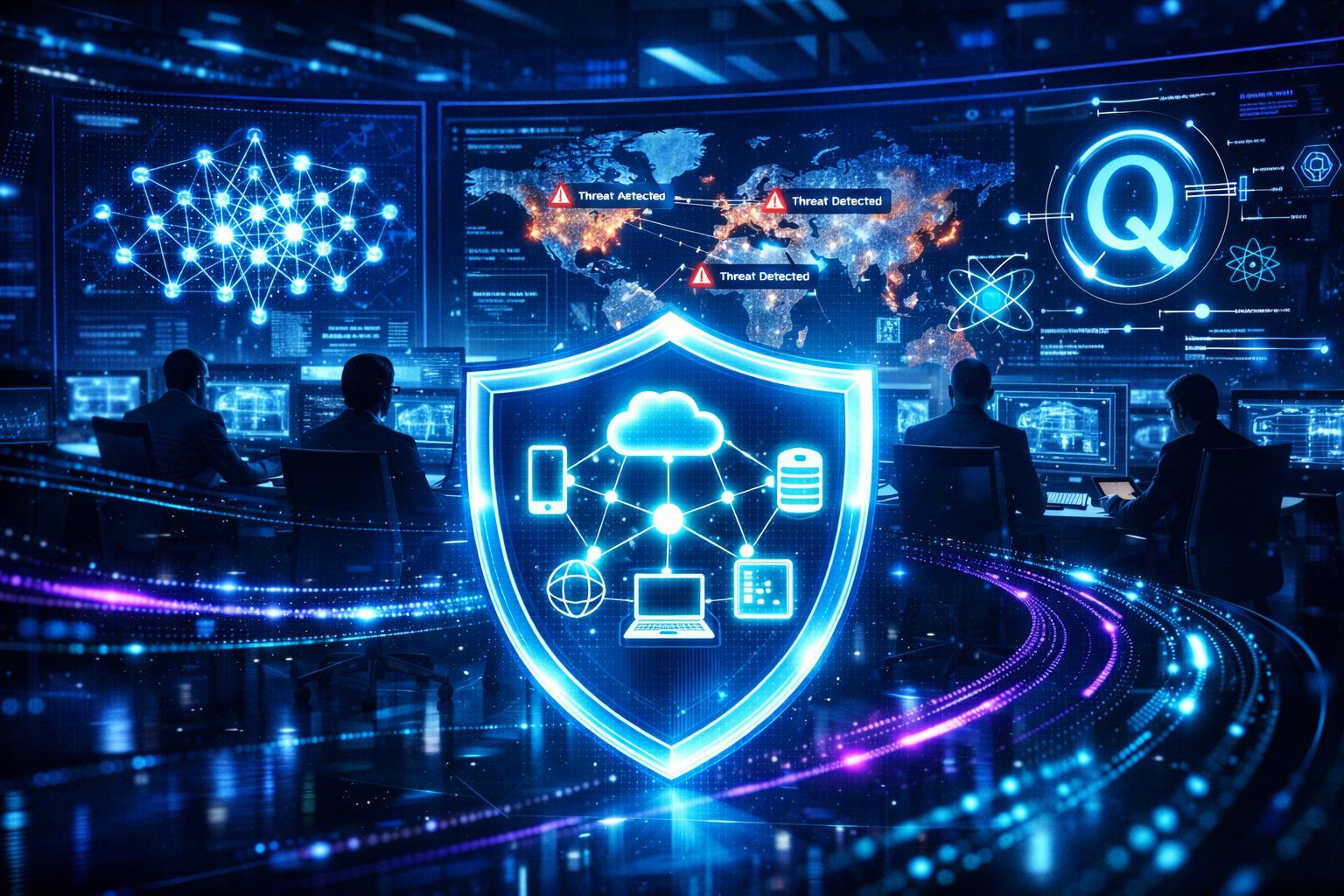
This is where AI comes in. It is not a magical shield that solves every problem but an intelligent assistant that relieves and extends the human eye and mind. AI systems can analyze enormous volumes of data — from network traffic to endpoint logs to cloud activity — in real time. They detect patterns, anomalies and behaviors that would be difficult for humans to grasp at that speed and complexity.
Practical examples
1. Network anomaly detection:
Traditional systems look for known signatures. AI learns the normal behavior of a network and raises an alert when something unexpected happens, for example a server suddenly sending an unusually large amount of data to an external IP address when it never did before. That could indicate data exfiltration even if the exact malware signature is unknown.
2. User and entity behavior analytics UEBA:
AI-powered UEBA solutions build profiles of typical behavior for each user and entity such as servers or applications. If an employee who normally accesses certain internal systems only during business hours suddenly tries to access sensitive databases at night or downloads unusually large files, AI flags this deviation as a potential insider threat or a compromised account.
3. Automated triage and prioritization:
Instead of an endless list of alerts, AI can pre-filter, correlate and score them for risk. A single failed login may be harmless, but 500 failed login attempts from the same IP across different accounts within five minutes, followed by a successful login on another system, is a pattern AI will quickly identify as credential stuffing or a brute-force attack and prioritize highly. CA analysts can then focus on truly critical incidents.
4. Zero-day detection:
Because AI is not solely signature-based, it can detect unknown threats. If a new malware variant exhibits previously unseen behavior that deviates from learned normal patterns, AI can surface it. This is a decisive advantage against zero-day exploits that bypass traditional antivirus and IDS systems.
The human role remains essential
It is important to emphasize that AI does not replace human analysts but extends their capabilities. AI provides raw data, correlations and initial hypotheses. Humans bring context, intuition, critical thinking and the ability to make strategic decisions. AI can spot patterns, but humans must decide what those patterns mean and how to respond. At CA we view AI as a partner that frees analysts from repetitive tasks so they can focus on the most complex and strategically important aspects of cybersecurity.
Challenges and pitfalls
Deploying AI in cybersecurity is not without challenges:
- Data quality: AI is only as good as the data it is trained on. Poor or incomplete data leads to poor outcomes and false positives.
- Explainability: It is often difficult to trace why AI made a particular decision. This can hinder analyst acceptance and auditability.
- Adversarial AI: Attackers learn to evade or manipulate AI models to avoid detection. This requires continuous evolution of AI-based defenses.
- Cost and complexity: Implementing and maintaining AI solutions can be expensive and technically demanding.
The future: proactive and intelligent
Integration of AI into threat detection and incident response will deepen. We will see AI not only generate alerts but also initiate automated responses, for example isolating a compromised endpoint or blocking a malicious IP, always under human oversight and with clear governance rules. Threat hunting will become far more efficient through AI-driven hypothesis generation and data analysis. At CA we believe the future of cybersecurity lies in an intelligent symbiosis of human expertise and advanced AI, a symbiosis that helps us stay one step ahead of attackers.
Short checklist: AI in threat detection — are you ready?
- Data strategy: Do you have a clear strategy for collecting, storing and ensuring the quality of your security data?
- Expertise: Do your security teams have the skills needed to interpret and act on AI outputs?
- Process integration: Are AI outputs seamlessly integrated into your incident response processes?
- Governance: Do you have policies for AI use, especially regarding explainability and bias?
- Testing and validation: Do you regularly test and validate your AI models against new threats and tactics?
- Scalability: Can your AI solution scale with your data and infrastructure growth?